If you're a sole trader or running a small crew in Australia, you've probably come across Tradify and ServiceM8. They're the two names that dominate the trade software conversation, both with strong followings, decent features, and years of history behind them.
But they were both built with teams in mind. And the experience of using them as a solo operator (someone who quotes their own jobs, does the work, and handles the admin every night) is a different story to the marketing.
This is an honest comparison. I built Trackexa for sole traders after running my own painting business in Cairns, so I know where the frustrations come from. I'll tell you what each app does well, where they fall short for sole traders, and which one is likely the right fit for you.

The Short Version
If you just want the summary before diving in:
Tradify: Powerful, But Built for Teams
Tradify has been around for a long time and has a solid reputation, for good reason. The quoting and invoicing workflows are well-designed, calendar export/integration is available, and the mobile app is reliable on both iOS and Android. For a small team, it genuinely earns its place.
The problem for sole traders is the pricing model. Tradify charges per user per month, currently $48 AUD per user per month plus GST ($52.80 including GST) on their Lite plan (checked 5 October 2026). As a sole trader, you're the only user, so you're paying the full whack for a platform designed around team coordination features you'll never use. Timesheets for staff, job dispatching, subcontractor management. None of that applies to you on the tools alone.
There's also a strategic flag worth knowing about: Tradify was acquired by The Access Group in October 2024. The Access Group is a large enterprise software company. Historically, when enterprise players acquire niche SMB tools, the product roadmap gradually tilts toward bigger customers and the pricing eventually follows. It's early days, but sole traders would be wise to keep an eye on how Tradify evolves over the next year or two.
From a profitability standpoint, Tradify gives you job cost comparisons at the quote stage (useful), but we couldn't find a dedicated profit-per-hour figure in Tradify's public material. For a sole trader trying to understand whether their business is actually profitable, that's worth considering.
ServiceM8: Feature-Rich, Priced by Job Volume
ServiceM8 is an Australian-built product and it shows: the team clearly understands how small trade businesses operate. The free plan is genuinely useful for sole traders just starting out: up to 30 jobs a month, all the core features, and no credit card required. That's a more honest entry point than most competitors offer.
The pricing model above the free tier is worth scrutinising carefully though. ServiceM8 plans are priced by the number of jobs per month. If you do 80–100 jobs a month (not unusual for a busy tradie), you'll be on the Growing plan at $79/month or higher before long.
ServiceM8 has iPhone and Android apps. Its Android app has almost all the same features as its iOS app (per ServiceM8's help centre, checked Oct 2026).
ServiceM8 also pushes heavily toward automation features (booking forms, client notifications, GPS tracking) that are genuinely valuable for businesses with a high turnover of short repeat jobs. Pest control, HVAC call-outs, cleaning runs: this is where ServiceM8 shines. For project-based tradies doing fewer, larger jobs (builders, painters, carpenters), it can feel like paying for a lot of features you don't need. Painters in particular may find better value in software built for painting businesses that focuses on quoting, job costing, and profit tracking rather than rapid dispatch workflows. Painters can also read how to price a painting job in Australia.
Trackexa: Built Around the Profitability Question
I'll be upfront: I built Trackexa because I couldn't find what I actually needed as a sole trader running a painting business. I wanted to know, at the end of every job, whether I actually made money on it. Not just revenue. Profit. Per hour. After materials and time.
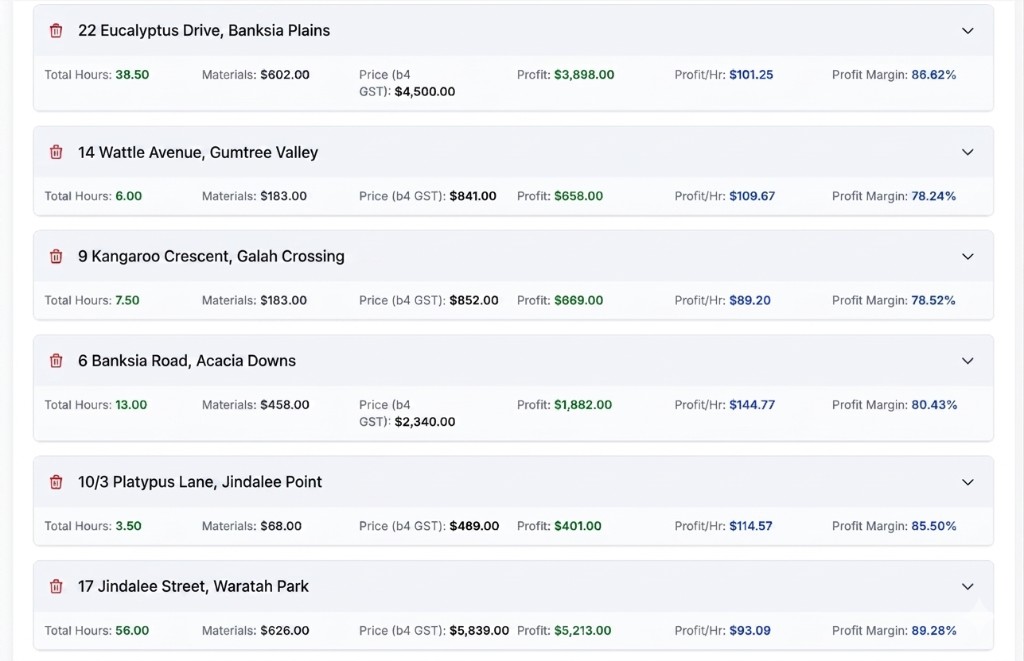
That number, profit per hour, is the single most important metric for a sole trader, and we could not find an exact profit-per-hour figure in Tradify or ServiceM8 public material. Trackexa does, for every job you log.
The other thing that mattered to me was the Australian financial year dashboard. Most apps use a calendar year (January to December) for reporting. That's useless for an Australian sole trader preparing for BAS or trying to understand their FY income. Trackexa runs July to June as standard, with GST-inclusive and GST-exclusive views.
Trackexa is a newer product than Tradify or ServiceM8 (honest about that). It doesn't have every feature those platforms have built over a decade. But for a sole trader who wants clarity on their business (quotes, invoices, job profitability, scheduling, tasks, and real financial year reporting), it covers the ground that matters without charging per-user fees or locking you into a job-credit model.
See profit per job from day one
Try Trackexa free, no credit card, no lock-in. Built for Australian sole traders who want to know what they're actually making.
Start free trial →Head-to-Head: The Features That Matter for Sole Traders
| Feature | Trackexa | Tradify | ServiceM8 |
|---|---|---|---|
| Profit per hour per job | ✓ Built in | Not verified | Not verified |
| Australian financial year dashboard | ✓ Built in | Not verified | Not verified |
| GST breakdown on income charts | ✓ Yes | Not verified | Not verified |
| Quotes & PDF invoices | ✓ Yes | ✓ | ✓ |
| Add to Google Calendar (one-way) | ✓ Yes | ✓ | Not verified |
| Android / phone apps | ✓ Yes | ✓ | ✓ iOS & Android apps |
| Free plan / free trial | ✓ Free trial | No free plan | ✓ Free plan |
| Pricing model | $39/mo inc GST | Per user/mo | Per job credits |
| Built specifically for sole traders | ✓ Yes | Team focus | Scales to teams |
| monthly income snapshot at a glance | ✓ Yes | Not verified | Not verified |
Prices and features checked 5 October 2026. Not verified means we could not confirm it in public material, not that the feature is unavailable.
The Pricing Reality for a Sole Trader
Pricing comparisons for trade software are often misleading because they compare headline prices without context. Here's the real picture for a typical Australian sole trader doing around 20–30 jobs a month:
Tradify Lite is $48 AUD per user per month plus GST ($52.80 including GST) on their Australian pricing page (checked 5 October 2026). There is no free plan. You are paying per-user pricing for a one-person operation from day one.
ServiceM8 has a genuine free plan capped at 30 jobs per month, worth trying if you're just getting started. Once you push past that, the Starter plan is $29 AUD/month for 50 jobs. If your job volume grows, costs step up quickly: the Growing plan at $79/month covers 150 jobs, and it keeps climbing from there. The job-credit model means your costs scale directly with your workload, which is the opposite of what a sole trader needs when things get busy.
Trackexa runs on a flat rate with a free trial, no per-user fees, no job-credit caps. Start free, get a feel for it, and if it works for your business, it stays at one predictable price regardless of how many jobs you run.
Which One Should You Choose?
Honest answer: it depends on what you actually need.
Choose Tradify if you're growing beyond solo and need to coordinate a small team: scheduling staff, tracking their time, dispatching jobs. It's the most mature team workflow tool of the three. Just go in with eyes open on the pricing and the new corporate ownership.
Choose ServiceM8 if you do a lot of short repeat jobs (call-outs, service runs, maintenance contracts), and you want automation features like booking forms and on-the-way SMS. The free plan is a genuinely good starting point. Be prepared for costs to rise as your job volume grows.
Choose Trackexa if you're a sole trader who wants to know, clearly and without digging, whether your business is actually profitable. If you want Australian financial year reporting built in, plus GST-inclusive and GST-exclusive views, profit per hour tracked on every job, and a clean quote-to-invoice workflow without paying per-user fees or counting job credits.
All three offer free trials or free plans. The best thing you can do is run a real month of your business through whichever one looks closest to what you need, and see how it actually feels on the tools. No demo environment is ever the same as live use. If you're also comparing other platforms like Jobber, check out our Jobber alternative for Australian tradies guide.