Stop guessing

Know exactly what you made
on every job.

Track profit per hour on every job you complete. See which work is worth doing and which jobs are losing you money, before you quote the next one. Built for Australian tradies with built-in FY and GST views.

✓ Track materials + hours
✓ See profit per hour
✓ Built for Aus tradies
The problem

Two kinds of work. One made $48 an hour. The other made about $100 an hour.

Without tracking profit per hour, you'll never know which jobs are worth repeating and which ones are losing you money. Most Australian tradies focus on total revenue or profit margin percentage, but profit per hour tells the real story of which work actually pays.

❌ Job A: Interior Repaint
Job Price
$2,400
Materials
$850
Hours
32
Profit
$1,550
Profit/Hr
$48.44
Margin
64.6%
Job took way longer than expected. Materials were higher than quoted. You made less than half your target hourly rate. Job A made a profit, but at about $48 an hour it paid less than half of a $100 target.
✅ Job B: Joel's other work (vs a 4-bedroom interior repaint)
Other work, Profit/Hr
~$100/hr
4-bed interior repaint, Profit/Hr
~$65/hr
On a 4-bedroom interior repaint, Joel made about $65 an hour once paint and materials came out. His other work was coming in at about $100 an hour. Both jobs felt busy and paid; only tracking profit per hour showed the gap. This is the work you should be quoting more of.

Without tracking profit per hour, both jobs feel the same. With tracking, you know exactly which work to prioritize.

Understanding the numbers

Why Profit Per Hour Beats Margin % or Charge-Out Rate

Australian tradies often track margin percentage or their hourly charge-out rate, but neither tells you what you're actually earning. Here's why profit per hour is the metric that matters.

💰
Margin % Hides Reality
Example: a $3,000 job with 70% margin sounds great, until you realise it took 42 hours. That's $50/hr. A $1,200 job at 60% margin done in 8 hours pays $90/hr. Margin percentage doesn't account for your time.
⏰
Charge-Out Rate ≠ Take-Home
Charging $100/hr means nothing if materials ate 40% and the job took twice as long as quoted. What you charged versus what you earned are two different numbers, and most tradies only track the first one.
📊
Profit/Hr = Job Profit ÷ Hours
Profit per hour in Trackexa = job value (ex GST) minus the job costs you record, divided by the hours you log. It is before overheads, tax and super, so it is not your take-home pay. It's the only number that tells you which jobs are worth doing and which ones to walk away from.
Worked examples

Worked Australian Tradie Examples, Painting & Sole Trader Jobs

Example scenarios only. Figures are illustrative and not from a specific Trackexa export. All figures are ex-GST to show true profit calculation, the way you should be tracking internally.

❌ Example 1: Interior House Repaint (Sydney)
Quoted (ex-GST)
$3,600
Materials Cost
$950
Hours Worked
42
Profit (Job Price − Materials)
$2,650
Profit Per Hour
$63.10
Margin %
73.6%
Margin looks great on paper (73%), but the job dragged out, lots of prep, customer changes, two extra coats in the hallway. At $63/hr profit before tax and super, you may still be below your target once vehicle, insurance and other overheads are factored in. This type of job often needs to be priced higher or avoided.
✅ Example 2: Exterior Repaint (Brisbane)
Quoted (ex-GST)
$2,200
Materials Cost
$420
Hours Worked
16
Profit (Job Price − Materials)
$1,780
Profit Per Hour
$111.25
Margin %
80.9%
Straightforward outdoor job, light prep, two coats, done. Lower quote than Example 1, but 76% better hourly profit ($111 vs $63). Finished a day early. Materials under budget. This is the work you want to fill your calendar with.
❌ Example 3: Small Commercial Fitout (Melbourne)
Quoted (ex-GST)
$8,500
Materials Cost
$2,100
Hours Worked
88
Profit (Job Price − Materials)
$6,400
Profit Per Hour
$72.73
Margin %
75.3%
Big invoice ($8,500) and decent margin (75%), looks profitable until you track hours. Travel across the city, waiting for other trades, redoing sections after builder changed the layout. 88 hours for $72/hr profit. In the same 88 hours, jobs like Example 2 would have made about $9,790 profit ($111 an hour).
✅ Example 4: Exterior Weatherboard Refresh (Adelaide)
Quoted (ex-GST)
$4,800
Materials Cost
$680
Hours Worked
32
Profit (Job Price − Materials)
$4,120
Profit Per Hour
$128.75
Margin %
85.8%
Clean exterior work, no interior prep headaches, no furniture to move, good access, perfect weather. Job went like clockwork. $128/hr profit is what experienced sole traders should be aiming for on their best work. Track jobs like this and replicate them.

Key insight: The highest invoice (Example 3: $8,500) had the second-lowest hourly profit. The smallest job (Example 2: $2,200) had the second-highest profit per hour. Invoice size means nothing, profit per hour is everything.

Australian FY & GST

GST Clarity: How to Track Profit Ex-GST vs Quoting Inc-GST

One of the biggest mistakes Australian tradies make: mixing up GST-inclusive and GST-exclusive figures when calculating profit. Here's how to do it correctly.

📋
When Quoting: Inc-GST
Customers see GST-inclusive prices. If you quote $2,200 for a job, that's $2,200 inc-GST. Customer pays $2,200. Simple. But don't use this number to calculate profit, you owe $200 to the ATO.
💰
When Costing: Ex-GST
For profit tracking, always work ex-GST. That $2,200 quote is actually $2,000 ex-GST revenue to you. Materials of $400 inc-GST are $363.64 ex-GST cost. Track ex-GST or your profit numbers will be inflated by 10%.
🧮
The Formula
Profit per hour = (Job Price ex-GST − Materials ex-GST) ÷ Total Hours. If your accounting software or job tracker doesn't split GST automatically, divide inc-GST figures by 1.1 to get ex-GST. Always track profit ex-GST.
Worked example: a 4-bedroom interior repaint (Joel's own job)

Step 1: Convert the paint and materials receipts to ex-GST (divide inc-GST by 1.1).

Step 2: Subtract those ex-GST costs from the ex-GST job price to get profit.

Step 3: Divide that profit by the total hours on the job.

Result: Joel's 4-bedroom interior repaint worked out to about $65/hr after paint and materials, compared with about $100/hr on his other work.

Why this matters: If you calculate profit using inc-GST figures, your numbers will be 10% too high. You'll think you're profitable when you're barely breaking even. Enter job value and costs ex GST so your profit is not overstated. Trackexa shows your income including and excluding GST automatically. It does not split GST out of costs.

Financial year tracking

Why Your Average $/Hr Across the Full Australian FY Matters

One good month doesn't mean your business is profitable. One bad month doesn't mean it's failing. The Australian financial year average tells the real story, and it's the number that matters come tax time.

📅 Tracking Profit Per Hour Across FY 2025–26

Most Australian tradies have seasonal variation. December is quiet (everyone's on holidays). January is slow to restart. March is busy (tax time approaching). Tracking your FY average smooths out the peaks and troughs.

Jul–Sep 2025
$94/hr
Oct–Dec 2025
$68/hr
Jan–Mar 2026
$118/hr
Apr–Jun 2026
$102/hr
FY 2025–26 Average
$95.50/hr
Total FY Hours
1,680
Your Q2 was rough ($68/hr average, Dec holidays killed you). But Q3 bounced back hard ($118/hr, tax season work). Your FY average of $95.50/hr across 1,680 hours means you cleared roughly $160,440 profit for the year before tax. That's the number your accountant cares about, and the number you should be tracking.
📉 What Happens If You Don't Track FY Average

You have a great March, three high-paying jobs, $140/hr average. You think you're killing it. You buy a new ute on finance.

Then you look back at the full FY in June. Turns out March was an outlier. Your FY average was $64/hr. After tax, super, and overheads, you barely broke even.

Without FY tracking, you make business decisions based on your best month instead of your real average. That's how tradies end up overcommitted and underpaid.

Trackexa tracks your FY average automatically, total profit, total hours, average $/hr across Jul 1–Jun 30. No spreadsheets, no manual adds. Just your real number for the full Australian financial year.

How it works

Track profit in 3 simple steps

Trackexa's profit tracker is built for speed. Add a job, log your hours and materials, and see your profit per hour instantly.

1
Add the job
Enter job address, type, and quoted price. Takes 30 seconds.
2
Track materials + hours
Log materials cost and add work entries (date, hours, description) as you go or all at once when the job finishes.
3
See profit per hour
Trackexa calculates total hours, profit, profit per hour, and margin automatically. No spreadsheets, no math.
See it in action

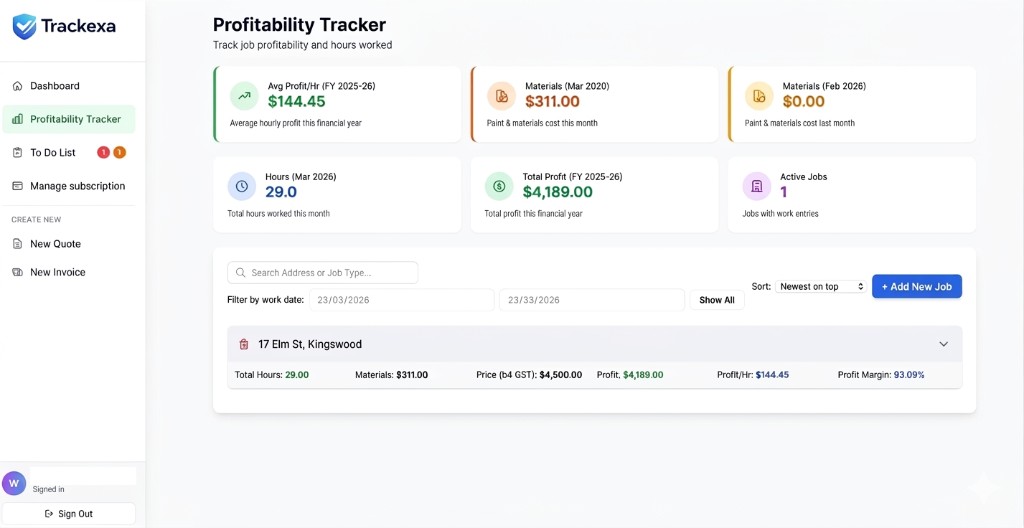
Your profit tracker dashboard

Every job shows profit, profit per hour, and margin at a glance. Plus summary metrics for your full financial year.

Example Trackexa Profitability Tracker screen (details changed) showing profit per hour, job margins, and financial year summary metrics

Example screen (details changed)

$98
Avg profit/hr, example figures only
$24,500
Total FY profit
250h
Current month hours
Common questions

Profit Per Hour FAQ, Australian Tradie Edition

The most common questions we get from Australian tradies about tracking profit per hour, materials, billable time, and which jobs to repeat.

Do I count travel time as billable hours?

Short answer: Yes, if you're tracking profit per hour honestly. Your time is your time, whether you're on the tools or in the ute.

If a job takes 6 hours on site but 2 hours round-trip travel, your real time input is 8 hours. Dividing profit by 6 hours gives you a false number. Some tradies bill travel separately (call-out fee), others bake it into the quote. Either way, count it when calculating your true hourly profit.

What about materials: do I include supplier pickup time?

Yes. If you spent 45 minutes driving to Bunnings and loading paint, that's 0.75 hours for that job. Add it to your total hours.

Materials cost is the dollar amount (ex-GST). Materials pickup time is labour. It's part of your hours worked. The formula is: Profit ÷ (Site Hours + Travel + Materials Run + Admin). If you don't count pickup time, your hourly rate is inflated.

Should I track profit per hour on quoted jobs vs actual cost jobs?

Track both, but only compare quoted fixed-price jobs to other quoted jobs. Time-and-materials work (where you bill hourly) will always show higher $/hr because there's no risk. You're paid for every hour.

Fixed-price quoted jobs are where profit per hour really matters. That's where you win or lose based on how well you estimated hours and materials. If your quoted work averages $65/hr and your T&M work averages $95/hr, you're underquoting. Lift your fixed-price rates.

How do I know which jobs to repeat vs avoid?

Track 10–20 jobs, then look for patterns. You'll notice some job types consistently pay well (e.g. straightforward exterior repaints) and others consistently drag (e.g. small interior touch-ups, commercial fitouts with other trades on site).

Set a threshold, say $85/hr profit. Any job type that averages below that across 3+ examples is a candidate to either reprice or stop quoting.

Example: You track 5 small bathroom repaints. They average $58/hr profit. You track 4 exterior repaints. They average $107/hr. Decision is easy: chase more exterior work, price bathroom repaints 40% higher or decline them.

What's a realistic profit per hour target for a sole trader painter in Australia?

Rough guide only (not survey data): $70–$120/hr profit (ex-GST, after materials, before tax).

Under $70/hr → You're underpricing or working inefficiently. After tax, super, and vehicle/tool costs, you're earning less than you would as an employee.

$70–$95/hr → Decent. You're making a living. Not getting rich, but sustainable if your overheads are low.

$95–$120/hr → Good. This is where experienced sole traders should be. Enough margin to handle quiet months, take holidays, and invest in the business.

$120+/hr → Excellent. You're in the top tier, either working a high-margin niche (e.g. heritage restoration, specialty finishes) or you've nailed your quoting and efficiency. Keep doing what you're doing.
Do I include my own super and tax when calculating profit per hour?

No. Profit per hour is calculated before your personal tax and super. It's a business metric, not a personal take-home metric.

Here's the order:
1. Job Revenue (ex-GST), what the customer paid minus GST
2. Minus Materials, direct job costs
3. = Profit, this is what you divide by hours to get profit/hr
4. Minus Business Overheads (vehicle, insurance, tools, software), what's left is business profit
5. Minus Tax & Super, what's left is your personal take-home

Profit per hour sits at step 3. If you're averaging $100/hr profit across the FY, expect roughly $60–$70/hr personal take-home after tax, super, and business costs. Still decent, but it shows why $100/hr profit is the minimum target, not the dream number.

Can I track profit per hour if I employ someone or use subbies?

Yes, but the formula changes slightly. If you're paying labour (employee or subcontractor), treat their cost the same as materials. It's a direct job cost.

Formula for jobs with labour:
Profit per hour = (Job Revenue − Materials − Labour Cost) ÷ Your Hours Worked

Example: $5,000 job, $800 materials, $1,200 subbie labour, you worked 20 hours → Profit = $5,000 − $800 − $1,200 = $3,000. Profit per hour = $3,000 ÷ 20 = $150/hr. This shows your profit per hour of your time when you're coordinating labour, a different (and often better) model than doing all the work yourself.

Related Resources

More alternatives & resources

Compare job management software options built for Australian tradies, or dive deeper into profit tracking with our detailed guides.

🧮
Free Job Return Calculator
What did that job really pay you? Work out one job's real hourly rate in your browser. No signup, nothing saved. Try the calculator →
📖
How to Calculate Profit Per Hour
Step-by-step guide with real painting job examples, free spreadsheet template, and the exact formula to use. Read the full guide →
💡
Why Tradies Don't Know Their True Hourly Rate
In my experience, the real number is often a lot lower than the rate on the invoice. Find out why and how to fix it. Read the article →
🇦🇺
Australian Tradie Software
Compare job management software for tradies with Australian FY, GST, and profit tracking built in. View buyer's guide →
🔄
Tradify Alternative
Simpler alternative for Australian sole traders with flat AUD pricing and profit-per-hour tracking. Compare Tradify vs Trackexa →
📱
ServiceM8 Alternative
Australian-built alternative with built-in profit tracking and financial year metrics. Compare ServiceM8 vs Trackexa →
🛠️
Jobber Alternative
Flat AUD pricing and Australian FY built in. See how Trackexa compares. Compare Jobber vs Trackexa →
🎨
Painter Software
Built by a painter for painters, job tracking, quoting, and profit per hour in one tool. Learn more →
🔧
Fergus Alternative
Lighter alternative with flat AUD pricing and Australian FY support. Compare Fergus vs Trackexa →

Start tracking profit per hour today.

Try Trackexa's profit tracker free for 14 days. No credit card required. See which jobs are making you money, and which ones are quietly bleeding you dry. Built for Australian tradies with FY and GST handled automatically.

Start Free Trial, No Card Needed →

14-day free trial · $39/month including GST after · Profit tracking + quotes + invoices · Australian FY & GST collected views · Cancel anytime